
Go is still fighting over generics. In 2019.

I dislike Go. I dislike it a lot. Nevertheless, I usually do not bash on it because I am deeply convinced that people should use whatever they want and they like. Many people I respect use Go. I mean, this blog run on Hugo, that is written in Go! How could I be one of “those guys” who always bitch about what other people enjoy?
However, sometimes, I fall into watching discussions in the go community, and they are so absurd I cannot shut up.
[Link] Go: the Good, the Bad and the Ugly
![Header image for [Link] Go: the Good, the Bad and the Ugly](/images/default_hu_45969faaa6832513.jpeg)
My opinion is that talking about languages is usually a very unproductive use of time. If these discussions are just cat fights, then it is even worse. Unless you are a language designer, you are writing a language or study a language, you should just use a language and nobody should care.
But good articles on language pro and cons are always nice. They may be helpful to choose the right tool for the problem. For this reason I link a good article on Go. And that’s the last time I’ll talk about Go.
Any news from Clojure front?
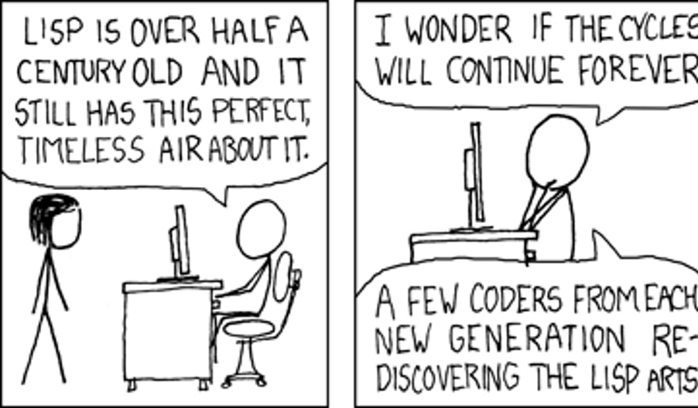
Some days ago, I was cleaning my Code folder from old snippets and test projects when I found an old Clojure package I did to test some Clojure feature. I remember that I kept the project sleeping in my Code folder because I thought that it would come in handy when Clojure 1.9 would be released. However, I left that project stub back in February 2016, more than a year ago. That raise the question: where is Clojure 1.9?
The most promising languages of 2015 - Part 2
UPDATE: There is a new version of this article for 2016!
In the the previous post we have seen what are the general trends of the previous year with regard to the fascinating world of programming languages. To summarize, we can say the there are two strong trends: 1) more functional-inspired elements in programming languages 2) more statically strong typed languages that can be compiled in machine code.
Now, in the current article, I want to list all the languages which have attracted interests in the last years and that represent the implementation of these trends. Obviously, as I said in the previous article, these are not languages on which to bet their careers: these are new trendy languages but the real world does not work on “trends”, but on software, oil, commerce, health care and an hundred of categories in which the actual programming languages are doing great with an huge amount of per-existing codebase.
However, it is nice to explore the “future”, so, let’s take a look.